The Last Bottleneck: How an Explosives Shortage Is Rationing Kazakhstan's Mineral Boom
Kazakhstan has the capital, the ratings and the orebodies. What it does not have is enough legally produced blasting agent — and in a country now rated investment grade by all three major agencies, the right to blast has quietly become the scarcest commodity of all.
Disclosure. Gliese Capital is completing an 80,000-tonne-per-annum emulsion explosives facility in Kazakhstan, described in the final section of this article. This analysis is therefore written by an interested participant in the market it describes, and readers should weigh it accordingly. Key sources are listed at the end; figures identified as estimates are the author's own calculations on stated assumptions.
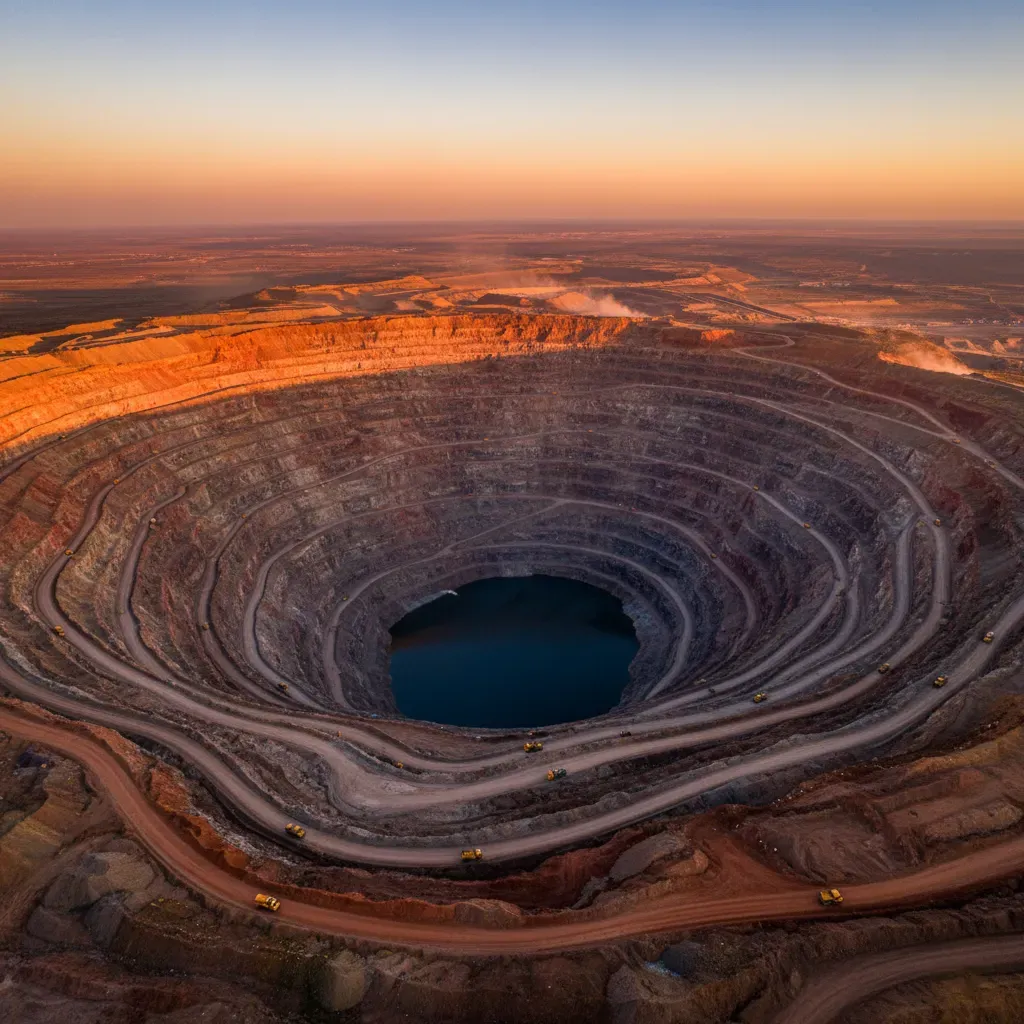
Somewhere in central Kazakhstan this morning, a mine that has everything is waiting. It has an investment-grade sovereign above it, a signed offtake behind it, a fleet of 200-tonne haul trucks idling on the ramp, and a resource statement thick enough to stop a door. What it does not have is an allocation of bulk emulsion, the explosive charge that turns an orebody into ore. Until that arrives, everything else it owns is scenery.
Every mineral security briefing written in the past eighteen months has fixed its gaze on the same handful of commodities: rare earths in Africa, lithium in the Atacama, cobalt in the Congo. Almost none has asked the more prosaic question that decides whether any of Kazakhstan's rock ever leaves the ground at all. You cannot mine what you cannot blast. In a country now rated investment grade by all three major agencies, the right to blast has quietly become the scarcest commodity of all.
This is not a story about geology. Kazakhstan has never had a resource problem. It is a story about a single, unglamorous industrial input that a security-linked licensing regime keeps in very few hands, that as a practical matter cannot be bought abroad, and that a booming economy is now consuming faster than the domestic industry can supply. Gold mines cannot expand on schedule. Fertiliser complexes queue for the same blasted rock. Copper deposits worth billions sit waiting on a resource nobody outside the country is currently permitted to sell them. Call it the last bottleneck in an otherwise remarkably open economy.
An Economy Re-Rated
Start with the headline numbers, because they are extraordinary by any regional standard. Kazakhstan's economy grew by 6.5 per cent in 2025, according to preliminary data from the Bureau of National Statistics, its fastest expansion in over a decade, driven by industry, transport, construction and trade rather than the oil windfalls that used to do the heavy lifting. Foreign direct investment reached USD 20.5 billion for the year, up 14.4 per cent on 2024, with the government reportedly targeting USD 25.5 billion in 2026. Government debt sits at around 23 per cent of GDP, roughly half the median for the country's rating category. Gross foreign-currency reserves ended 2025 at USD 65.4 billion, swollen by gold's rally, which now accounts for about 72 per cent of the pile, while the National Fund's foreign assets reached USD 63.9 billion: close to USD 130 billion between them.
The rating agencies have taken notice, and they have not finished moving. Fitch affirmed Kazakhstan at BBB with a stable outlook in June. Moody's holds the sovereign at Baa1, an upgrade from Baa2 secured in September 2024. S&P, most tellingly, revised its outlook on Kazakhstan's BBB- rating from stable to positive in August 2025 and reaffirmed that stance on 20 February 2026, crediting fiscal consolidation under the new tax code approved in July 2025 and continued reserve accumulation. A positive outlook sustained across two consecutive reviews is not decoration. It is the conventional precursor to an upgrade, and enough analysts now expect one, plausibly around the turn of 2026 into 2027, that a full house of investment-grade ratings looks set to become something stronger still.
Fairness requires the other half of S&P's note. The agency expects real growth to moderate to about 4 per cent a year through 2028, and oil output to fall roughly 4 per cent in 2026, to about 96 million tonnes, following attacks on Caspian Pipeline Consortium infrastructure. Far from weakening this article's argument, the shift strengthens it. The growth that remains is precisely the industrial, mining and construction growth that consumes blasting agent, while the hydrocarbons that still supply nearly 20 per cent of GDP and over half of exports are the part slowing down.
The Auction Block
None of this would matter to a resources investor were the underlying endowment not equally serious. Kazakhstan is the world's largest uranium producer by a wide margin, supplying roughly 40 per cent of global output. It holds the world's largest chromium reserves, about 230 million of the world's roughly 560 million tonnes, per the US Geological Survey, or around 40 per cent of the global total. The country ranks among the top ten global producers of gold, zinc, lead and titanium, alongside a substantial copper, phosphate, oil and gas base.
What has changed is how that endowment is allocated. The old model of opaque, negotiated licences has given way to the Unified Subsoil Use Platform at minerals.e-qazyna.kz, a fully digital system through which both solid mineral and hydrocarbon rights are now auctioned. The government has already put more than one hundred solid mineral deposits up for competitive tender, with recent rounds covering silver, lead, zinc, gold and rare metals drawing bidders from the United States, the European Union and China alongside the usual regional names. Amendments approved by the Senate in December 2025 go further, formalising electronic auctions in law and creating a priority route for strategic investors on projects above a defined threshold, while the Development Bank of Kazakhstan launched a USD 1 billion financing programme in October 2025 for the extraction and processing of critical materials. Whatever criticisms were once fairly levelled at the transparency of Kazakhstan's licensing regime, they are steadily losing their force.
The tungsten story shows how far the door has swung open. President Tokayev stood beside President Trump at the C5+1 summit in Washington on 6 November 2025, with Commerce Secretary Howard Lutnick and Industry Minister Yersayin Nagaspayev signing the critical-minerals memorandum; the headline transaction was Cove Kaz Capital's agreement to take 70 per cent of Severniy Katpar LLP, holder of the Northern Katpar and Upper Kairakty licences, the largest known undeveloped tungsten resource on earth, at 1.4 million tonnes of tungsten trioxide under an April 2023 JORC statement, with national miner Tau-Ken Samruk retaining 30 per cent. Development costs are put at USD 1.1 billion; the US Export-Import Bank has issued a Letter of Interest for up to USD 900 million and the Development Finance Corporation for up to USD 700 million. The acquisition closed on 29 April 2026, a definitive feasibility study begins in the second half of this year, and planned output of 12,000 tonnes a year would represent roughly 15 per cent of current global production, while the vehicle merges toward a Nasdaq listing as Kaz Resources.
The story less often told is what happens once an investor walks through one of those open doors and discovers that the single input every mine actually needs, the explosive charge that breaks the rock, is produced under licence by a handful of domestic firms who cannot keep pace with demand.
The Chokepoint Nobody Prices In
Here is the part the auction platform does not show you. Winning a mining right in Kazakhstan does not, by itself, buy the means to extract anything from it. Industrial explosives, the bulk emulsion and ANFO-based products that break rock at every open pit in the country, sit under one of the tightest regulatory regimes in the economy, and precision matters about how that door is closed, because the mechanism is the investment case.
The handling of explosives and items using them is a licensable field of activity under Kazakhstan's Law on Permits and Notifications (No. 202-V of 16 May 2014). The import and export of explosive materials are subject to state licensing under government resolutions whose qualification requirements route applicants through the territorial units of the industrial-safety authority, with a further layer of Eurasian Economic Union non-tariff regulation applying at the customs-union level. The practical effect, market participants report, is a market closed to imported finished product: licences to bring utility-scale explosives across the border are not, in practice, forthcoming, whatever the paper procedure implies. A formal confirming note from Kazakh counsel and a substantive response from the Ministry of Industry and Construction's industrial-safety committee have both been requested and remain outstanding at the time of publication; this section will be updated on receipt.
Two nuances an honest account must carry. First, the barrier is better described as a licensing wall than a statute that names and bars the product; that means it could, in principle, be lowered by the same administrative pen that raised it. Second, Kazakhstan's technical regulations do contemplate the simplest granulated ammonium-nitrate mixtures being prepared at mining organisations themselves. What an operator cannot do without a production licence, rarely granted and tied to security vetting, is manufacture the modern, water-resistant bulk emulsions on which large-scale open-pit mining now runs, or buy them from abroad.
Why so tight? Because the dual-use concern is not abstract. Investigative reporting by OCCRP and its partners has documented a sharp post-2022 rise in Kazakh exports of cotton pulp, a feedstock for gunpowder and explosives, to sanctioned Russian powder plants, findings that placed the country's handling of energetic materials under uncomfortable international scrutiny. A state managing that spotlight does not loosen its grip on finished explosives. If anything, it tightens it.
The product itself has been evolving in the same direction. Kazakhstan's mines have shifted steadily away from older ANFO and granulite-based explosives towards water-resistant bulk emulsions, which travel to the blast site as an inert, non-explosive matrix and are sensitised only at the well, minutes before use. The appeal to regulators is obvious: a material that can only detonate for the few minutes it sits in a drilled blasthole is a far less attractive target for diversion than a warehouse of finished product. That is precisely why the state has encouraged the transition, and why every serious new entrant is building emulsion capacity rather than legacy alternatives.
For a mining or oil and gas operator, this single architecture reorders the entire investment calculus. Capital, geology and offtake agreements are, in the end, negotiable. The physical tonnage of explosives available to blast an orebody is not.
Three Names and a Disputed Number
Three names dominate utility-scale production. Orica, the Australian multinational and the world's largest explosives manufacturer, has operated in Kazakhstan since 2002, when it commissioned its first emulsion plant in Ust-Kamenogorsk; a second plant followed in 2012 in Ekibastuz, oriented to the coal enterprises of Pavlodar region, and between them they supply KAZ Minerals' flagship Aktogay and Bozshakol copper operations, Kazzinc, Altynalmas and the Eurasian Resources Group. Maxam, the Spanish group whose lineage traces to Alfred Nobel's 1872 Spanish dynamite venture, has built a regional footprint spanning Kazakhstan, Russia and Mongolia in bulk and packaged product. The third name is domestic: Interrin, a Kazakhstani scientific-production enterprise with ten production sites, roughly 1,500 employees and blasting operations at some thirty open pits.
Now for the honesty the sector rarely gets: nobody outside the regulator knows the supply number precisely. Interrin's own materials have claimed output as high as 60,000 tonnes of explosives a year across its product lines; the incumbents' utility-scale bulk production is more commonly put at 25,000 to 30,000 tonnes each. Combined large-volume output therefore sits somewhere in the order of 75,000 to 110,000 tonnes a year depending on how capacity is counted; company disclosures are inconsistent, and no official production statistic is published. For scale, the global commercial explosives market moved about 17.4 million tonnes in 2025 and is growing at roughly 5 per cent a year. Kazakhstan's entire licensed output is a rounding error against the ambitions described below. Requests for comment and for an official production figure have gone to the industrial-safety authority, Orica Kazakhstan, Maxam and Interrin; none had responded by the time of publication, and this section will be updated with their replies, or with a note of their refusal, as they arrive.
The Arithmetic Nobody Publishes
Assertions of shortage are cheap; arithmetic is better. A rough demand model needs only two inputs: the tonnes of rock to be blasted, and a powder factor, the kilograms of explosive consumed per tonne of rock, which in open-pit hard-rock mining typically runs in the region of 0.15 to 0.35 kg per tonne once waste stripping is included. The ranges that follow are the author's estimates on those stated assumptions; they are illustrative, not measurements.
Apply it to a single project. The concentrator at Koksay is designed for 50 million tonnes of ore a year; with waste stripping, total material moved will plausibly run to two or three times that. At 100 to 150 million tonnes of rock and conventional powder factors, one mine could consume 20,000 to 50,000 tonnes of explosives a year at full tilt: up to half of everything the incumbent industry currently produces.
Now scale up. Deputy Industry Minister Olzhas Saparbekov has said that launching the Aidarly, Koksay and Benkala deposits will double national copper ore extraction to 300 million tonnes a year, with iron ore up 40 per cent to 52 million tonnes on the back of Qarmet's expansion and new hot-briquetted iron projects. On ore alone, 300 million tonnes of copper rock at 0.15 to 0.35 kg per tonne implies 45,000 to 105,000 tonnes of explosives a year, before a single tonne of waste rock is counted and before gold, phosphate, quarrying and construction take their share.
Coal is the baseline everything else stacks on. The vast Ekibastuz open-cast pits are the country's classic bulk-explosives consumers, the reason Orica sited its second Kazakh plant there in 2012, and they blast year in, year out, regardless of what the metals cycle does. Any honest demand model starts with coal and adds the new metals wave on top.
Strip ratios, rock hardness and free-dig fractions all move the answer, and readers should treat the ranges as such. But under any defensible set of assumptions the conclusion is the same: structural demand runs far ahead of the roughly one hundred thousand tonnes the licensed industry produces. Growth, in other words, is being rationed not by demand, not by capital, and not even by geology, but by tonnes of emulsion.
The Deficit, Case by Case
Take gold. RG Gold operates the Raygorodok deposit in the Akmola region, one of the country's largest, with JORC-reported reserves of 5.9 million ounces. A cyanidation plant commissioned in 2022, an investment of some USD 420 million, transformed the asset: output climbed from 2 tonnes of gold in 2022 to 5.9 tonnes in 2023 and 6 tonnes in 2024, with roughly 190,000 ounces expected for 2025, at a 2024 production cost of USD 796 per ounce. That performance drew China's Zijin Mining into a USD 1.2 billion acquisition agreed in June 2025 and completed that autumn, its second major gold purchase of the year after Ghana's Akyem, from Cantech S.a r.l., the Luxembourg vehicle associated with financier Bulat Utemuratov's Verny group. Zijin's own technical review sees average output of about 5.5 tonnes a year over a sixteen-year remaining life, and a path from the current run-rate toward 10 million tonnes per annum of mining and processing capacity. That is a textbook growth story: fresh capital, a marquee foreign acquirer, proven reserves, an expansion already scoped. How much of it converts into ounces depends on the volume of ore that can physically be blasted each year; on the arithmetic set out above, that is the binding constraint on this and every comparable expansion, and it is why a named, on-the-record account from the demand side, an allocations timetable from an actual mine or procurement office, would be worth more than any figure in this article. That is the next reporting step, and it is not yet done.
Take fertiliser. Kazphosphate, the country's dominant phosphorus producer since 1999 and successor to Soviet-era production in the Karatau basin, reported record output across its core lines in 2025, with ammonium phosphate volumes up 58 per cent on the previous year, according to the company. Its Zhanatas Chemical Complex plans what will be Kazakhstan's largest mineral fertiliser plant, with a designed capacity of one million tonnes a year and construction due to begin in late 2026. It will not be working alone. EuroChem is midway through its own billion-dollar-plus integrated phosphate project in the same Zhambyl region: a Phase I mining and beneficiation complex processing 840,000 tonnes of phosphate ore a year is running, a Phase II sulphuric acid plant, at 800,000 tonnes among the largest in the country, was commissioned in May 2026, and the Phase III chemical complex launches in 2027, taking total output above one million tonnes. Sozak Phosphate LLP is separately developing a further one-million-tonne NPK complex in Turkestan region. Three large, well-financed projects, all drawing on the same open-pit phosphate rock, all requiring the same blasted feed. The explosives arithmetic does not comfortably accommodate all three at full capacity. One of the three, moreover, belongs to a group with its own potential answer, of which more below.
Take copper. Kazakhmys is developing Koksay in the Zhetysu region: 823.7 million tonnes of ore containing 3.5 million tonnes of copper at 0.42 per cent, plus 63.7 tonnes of gold and 865 tonnes of silver, with a 50-million-tonne-per-annum concentrator and first production slated from 2026, in partnership with China's NFC, which took a stake in the project in 2018. Alongside it sits the even larger Aidarly deposit in the Abai region, with 5.87 million tonnes of contained copper at 0.38 per cent and its own concentrator planned by 2027. These are, on paper, precisely the large-scale, foreign-backed, government-prioritised projects the new licensing regime was designed to attract. Their eventual output, like everyone else's, will be shaped less by the size of the orebody than by how many tonnes of blasting agent the country can put at their disposal.
Different commodities, different companies, an identical constraint. This is not a series of isolated operational headaches. It is a structural ceiling sitting beneath the entire extractive economy, and it will apply with equal force to whatever is auctioned next on minerals.e-qazyna.kz.
The Feedstock Question
There is a second-order problem the market has barely begun to price: emulsions are, by mass, mostly ammonium nitrate. Kazakhstan has exactly one nitrogen producer, KazAzot in Aktau, with nameplate capacity in the region of 360,000 to 400,000 tonnes of nitrate a year, historically split roughly a third to farmers, a third to industrial consumers and a third to export, and now subject to state export controls designed to stabilise domestic supply. Relief is distant: the new KazAzot Prime complex, a USD 1.65 billion ammonia-urea-nitrate project also in Aktau, will add 500,000 tonnes of ammonium nitrate a year, though not until 2030.
Run the implication. An 80,000-tonne emulsion plant requires on the order of 55,000 to 65,000 tonnes of nitrate feedstock a year: roughly half of KazAzot's entire current output, and more than its whole historical industrial allocation. Any producer, incumbent or entrant, that has not secured feedstock has merely moved the bottleneck one step up the chain. It is the first question a serious reader should ask of every capacity announcement in this sector, including ours; our own arrangements are addressed in the disclosure section below, to the extent they can be at this stage.
What Could Break the Thesis
An analysis that names no risks is a pitch. Five could erode this one. First, incumbents can debottleneck: brownfield expansion at an already-licensed site is faster and cheaper than any greenfield build, and Orica and Maxam are global businesses with balance sheets to match. Second, vertical integration: EuroChem's wider group operates an industrial-explosives business in Russia, AzotTech, and whether it seeks Kazakh production licences to self-supply its phosphate operations is an open question; if it does, part of the fertiliser demand described above self-cannibalises. Third, the licensing wall is administrative rather than geological: the same state that keeps imports out could, under enough pressure from its own miners, let them in, and EAEU machinery for licensed imports already exists on paper. Fourth, project slippage: S&P already sees growth moderating and oil output falling after the pipeline attacks, and mega-projects in this region have missed dates before: demand deferred is margin deferred. Fifth, feedstock: nitrate scarcity binds everyone, and a producer without secured ammonium nitrate has capacity only in a brochure.
None of these, in our assessment, changes the direction of the imbalance this decade. All of them change its size. That is why they belong in print.
A Comparable Worth Studying
For investors who want a template, look at India. Behind a restrictive domestic licensing regime, Solar Industries grew into the country's largest private-sector explosives manufacturer, supplying roughly 70 per cent of the coal sector's needs and exporting to more than twenty countries: a business built almost entirely on the arithmetic of a protected home market attached to a giant mining complex. Kazakhstan in 2026 rhymes with that story: smaller, tighter, earlier. The consolidation of the global majors, Orica, Dyno Nobel, Maxam, Enaex, Austin Powder and AECI, tells the same lesson from the other end: in explosives, licensed capacity in the right jurisdiction is the whole game. What Kazakhstan has not yet produced is the delivered-price series that would let outsiders measure the scarcity premium directly; obtaining one is the single most valuable piece of primary research an allocator could commission on this market today.
Eighty Thousand Tonnes: Our Interest, Declared
This is where the author's firm enters the story, and the reader should weigh what follows accordingly. Gliese Capital has spent the past two years building what it believes is the answer: an 80,000-tonne-per-annum emulsion explosives facility in Kazakhstan, targeted for operational readiness in the first quarter of 2027, more than any single incumbent's utility-scale output today, and comparable to the combined bulk production of all three. Major mining, mining-services and oil and gas operators across the project pipeline described above have placed letters of intent that, in aggregate, cover the facility's prospective output; the aggregate figure is available for review, under NDA, by any qualified counterparty who asks. By our assessment, and it is an assessment resting on the security-linked authorisation regime described above rather than on any published moratorium, production licences of this scale will remain rare.
On feedstock, the question this article puts to every other producer is fair to put to us. The Company's ammonium-nitrate sourcing arrangements for the facility are not yet finalised for public disclosure; a specific, confirmed structure, whether a KazAzot offtake, an import licence for ammonium nitrate as a non-finished input, or captive solution capacity, will be published as an update once contractually settled, rather than asserted here in advance of that certainty.
The Only Scarcity Left to Price
Kazakhstan's investment case rarely needed much embellishment: 6.5 per cent growth, USD 20.5 billion in fresh foreign capital in a single year, investment-grade ratings from all three agencies with a credible path higher, and mineral wealth stretching from uranium to copper to phosphate to hydrocarbons. What is easy to miss, buried beneath the headline numbers, is that the country's next phase of growth is not primarily a question of capital, of licences, or even of geology. It is a question of tonnes of blasting agent: who makes them, who feeds them, and who gets the allocation. That is the number to watch on every Kazakh mining model from here. Not ounces. Not barrels. Tonnes of emulsion.